2026 cost benchmarks, New York minimum coverage requirements, and practical ways to compare liability-focused policies
This educational guide explains New York’s required coverages and statewide price benchmarks. Your actual rate will depend on your ZIP code, driving record, vehicle, coverage selections, household drivers, and discounts.
- Required liability limits: $25,000/$50,000 for bodily injury and $10,000 for property damage, commonly written as 25/50/10.
- Other required protection: $50,000 in basic no-fault benefits and $25,000/$50,000 in uninsured motorist bodily injury coverage.
- 2026 benchmark: approximately $148 per month for state-minimum coverage and $341 per month for full coverage.
- Important limitation: minimum coverage can satisfy state requirements but may leave you responsible for losses above your policy limits.
New York’s auto insurance market is among the country’s most expensive. A 2026 report citing Bankrate’s rate analysis placed average state-minimum coverage at approximately $148 per month ($1,773 per year) and full coverage auto insurance at approximately $341 per month ($4,092 per year). These are statewide estimates for defined sample drivers—not guaranteed prices.
Because prices are high, some drivers consider liability-only auto insurance to reduce the cost of optional protection. In New York, however, a state-minimum policy is not literally liability alone: it must also include basic no-fault protection and uninsured motorist coverage. Removing collision and comprehensive can lower a premium, but it also means your policy generally will not pay to repair or replace your own car after an at-fault crash, theft, vandalism, or weather damage.
New York’s Minimum Auto Insurance Requirements
For most vehicles, New York requires at least:
- $25,000 for bodily injury to one person in an accident
- $50,000 for bodily injury to two or more people in an accident
- $10,000 for property damage in one accident
- $50,000 in basic Personal Injury Protection (PIP), also called no-fault benefits
- $25,000/$50,000 in uninsured motorist bodily injury coverage for qualifying New York accidents
The familiar 25/50/10 shorthand does not show New York’s separate death limits. The required liability limits rise to $50,000 for the death of one person and $100,000 for the deaths of two or more people in one accident. Drivers should verify the current rules on the New York State DMV insurance requirements page before registering a vehicle or canceling coverage.
Liability coverage pays covered injury and property-damage claims made against you, up to your limits. It does not pay to repair your own vehicle. New York requires state-issued insurance to register and maintain the registration of a vehicle. A lapse can lead to registration and driver-license consequences, so plates should be surrendered before required coverage is canceled when applicable.
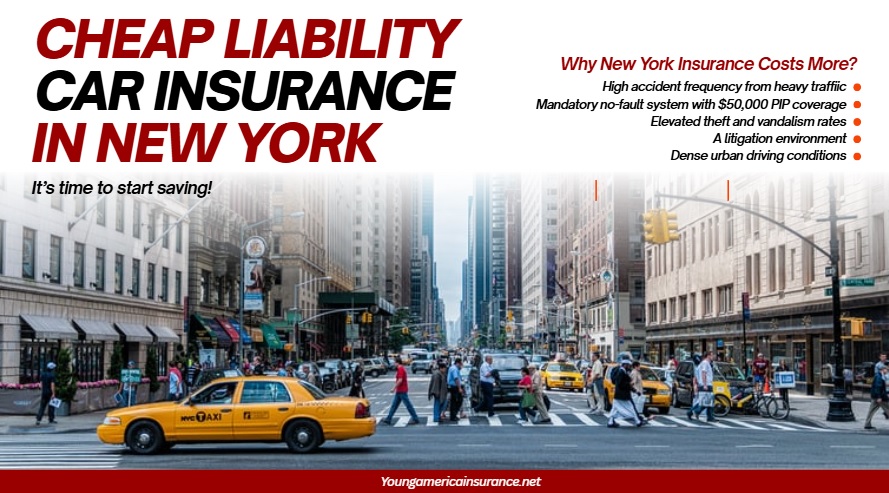
Why Car Insurance Costs Vary Across New York
A statewide average cannot predict a particular driver’s quote. Prices can differ substantially between New York City, Long Island, suburban counties, and upstate communities. Insurers also weigh driver- and vehicle-specific information differently.
| Factor | How it can affect a quote | What to compare |
|---|---|---|
| Location | Traffic density, claim frequency, repair costs, theft exposure, and other territorial data can vary by ZIP code. | Use the same garaging address on every quote. |
| Driving history | Accidents, violations, and prior claims can change eligibility and price. | Confirm that each insurer is rating the same drivers and incidents. |
| Vehicle | Repair cost, safety features, theft data, and vehicle use can influence premiums. | Enter the correct VIN, mileage, ownership, and use. |
| Coverage choices | Higher liability limits and optional collision, comprehensive, SUM, or additional PIP increase protection and may increase price. | Compare identical limits, deductibles, and endorsements. |
| Payment plan and discounts | Installment fees and eligibility for bundling, telematics, defensive-driving, or other discounts vary. | Compare the total policy cost, not only the first payment. |
How to Compare Lower-Cost New York Policies
There is no insurer that is reliably cheapest for every New York driver. A company that produces a low quote for one ZIP code, age, vehicle, or driving history may be expensive for another. Instead of relying on an unsourced ranking, compare several car insurance quotes using the same information and coverage limits.
- Choose the limits first. Decide whether the legal minimum provides enough protection for your income and assets.
- Quote the same policy design. Keep liability limits, household drivers, deductibles, optional coverages, and effective date consistent.
- Compare total cost. Include the initial payment, remaining installments, policy fees, and any discount conditions.
- Check the insurer and seller. Confirm that the company and agent or broker are authorized to conduct insurance business in New York.
- Review exclusions and endorsements. A lower premium is not equivalent if the coverage is materially different.
Liability Coverage for Teen Drivers in New York
Adding a newly licensed driver can increase a household’s premium, but the effect varies by insurer, vehicle, location, and eligibility for discounts. A teenager should not be omitted from an application merely to reduce the quote; household-driver disclosure requirements depend on the insurer and circumstances.
- Ask whether a documented good-student or approved driver-training discount is available.
- Compare the cost of assigning the teen to different household vehicles only when that assignment reflects actual use.
- Evaluate telematics terms, including what driving data is collected and whether poor results can affect price.
- For a financed or newer vehicle, check whether the lender requires collision and comprehensive coverage.
If broader protection is required, review full coverage options for higher-risk drivers, but do not assume that every young driver will be classified or priced the same way.
Liability Coverage for Older Drivers in New York
Age alone does not determine a quote. Driving history, mileage, vehicle, location, household drivers, and insurer rating rules also matter. Older drivers can compare:
- Approved accident-prevention course discounts and their eligibility requirements
- Low-mileage options when reported mileage reflects actual driving
- The combined cost of auto and home or renters coverage before accepting a bundle
- Higher liability and SUM limits when retirement income or assets could be exposed after a serious accident
Ways to Reduce the Cost Without Misrepresenting Coverage
- Compare several quotes using identical driver, vehicle, address, limit, and deductible information.
- Compare bundled and separate policies; a bundle discount does not guarantee the lowest combined cost.
- Review telematics carefully. Some pay-as-you-go car insurance programs use mileage or other driving data. Participation rules, data collection, and the effect of driving results vary by program.
- Compare payment plans. Some insurers offer installment or buy-now-pay-later options. Paying in full may avoid installment fees, but the savings must be confirmed in the quote.
- Avoid unintended lapses. Arrange replacement coverage before canceling an existing policy.
- Ask about documented discounts for which you actually qualify.
- Change deductibles only on applicable optional coverages. Liability coverage does not have a collision or comprehensive deductible.
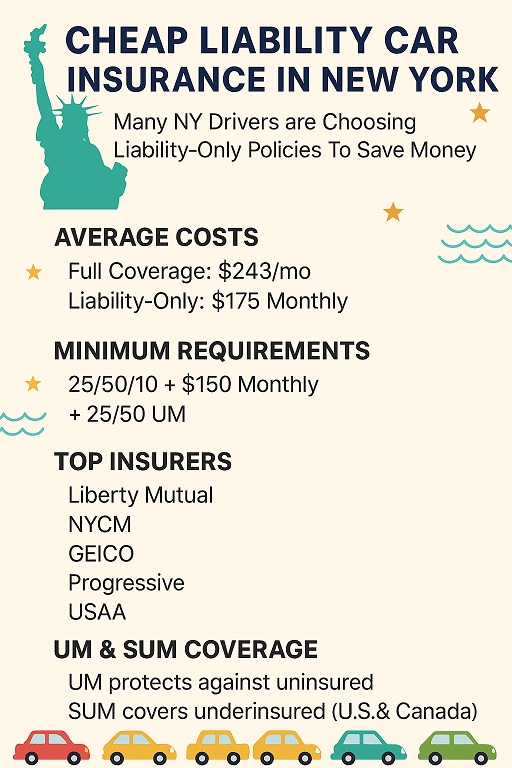
Uninsured Motorist Coverage in New York
Mandatory uninsured motorist (UM) coverage can pay covered bodily-injury claims for you, qualifying household family members, and occupants of your vehicle when an uninsured or hit-and-run driver is responsible. Basic New York UM coverage does not pay for damage to your vehicle.
The minimum UM bodily injury limits generally mirror the state’s minimum bodily injury liability limits:
- $25,000 per injured person
- $50,000 per accident involving two or more injured people
A limitation that deserves attention is territory: mandatory basic UM protection applies to qualifying accidents in New York. An endorsement or broader coverage may be needed for protection outside the state. Policy language controls, so confirm the territory on the declarations and endorsement pages.
Supplementary Uninsured/Underinsured Motorist Coverage
Supplementary Uninsured/Underinsured Motorist coverage, usually called SUM, can provide additional bodily-injury protection when the responsible driver has no insurance or insufficient liability limits. It does not replace collision coverage for damage to your vehicle.
When a New York auto policy is initially purchased, SUM is generally included at an amount equal to the policy’s bodily injury liability limits unless the named insured rejects it or selects a lower amount through the required waiver process. Available limits, offsets, covered people, territory, and claim conditions are governed by the policy and New York rules.
Drivers comparing SUM should check:
- The SUM limit shown on the declarations page
- Whether it matches the selected bodily injury liability limit
- The signed waiver, if a lower limit or rejection was selected
- Territorial coverage and household-member provisions
- Offsets and other claim conditions
Common Mistakes to Avoid
- Choosing minimum limits without considering losses that could exceed them
- Comparing monthly payments while ignoring total premium and fees
- Submitting different limits or driver information to different insurers
- Canceling an existing policy before replacement coverage takes effect
- Assuming that a statewide average represents a quote for NYC or an upstate ZIP code
- Removing collision and comprehensive without considering the value of the vehicle or lender requirements
Frequently Asked Questions
What liability limits are required in New York?
For most vehicles, the minimum is $25,000 per person and $50,000 per accident for bodily injury, plus $10,000 for property damage. Higher limits apply to deaths. New York policies must also include basic no-fault and uninsured motorist protection.
Can I register a car in New York without insurance?
Generally, no. New York State-issued automobile liability insurance must be in effect before the vehicle can be registered and must be maintained while the registration remains valid.
Which company has the cheapest liability insurance in New York?
No company is cheapest for every driver. The answer depends on the driver, ZIP code, vehicle, household, coverage limits, and rating rules. Compare multiple quotes with identical inputs instead of relying on a statewide company ranking.
Does a state-minimum policy cover damage to my own car?
Normally, it does not cover damage to your car from an at-fault collision, theft, vandalism, or weather. Collision and comprehensive are separate optional coverages, although a lender or leasing company may require them.
Is minimum coverage enough?
It satisfies the state’s basic insurance requirements, but that does not mean it is sufficient for every driver. Consider the value of potential claims, your ability to pay losses above the limits, and any lender requirements.
Final Considerations
Finding a lower-priced New York policy requires comparing equivalent coverage, not simply choosing the smallest monthly payment. Start with the required liability, PIP, and UM protection, then decide whether higher liability limits, SUM, collision, comprehensive, or additional PIP are appropriate for your financial situation.
Compare quotes from available insurers using the same drivers, vehicles, address, limits, and effective date. Review the complete premium and coverage terms before purchasing.
Editorial note: Insurance requirements and prices can change. This page provides general educational information and does not issue policies, determine eligibility, or guarantee rates or coverage.