Liability Only Auto Insurance
If your vehicle is more than ten years old and you don’t drive it much, you might consider buying liability-only auto insurance. Liability-only coverage is generally cheaper than a policy that also includes collision and comprehensive coverage, but it provides less protection for your own vehicle. There are also select providers in certain states that offer liability coverage with no deposit required. Check available rates now by entering your ZIP code.
Do you own a second vehicle that is only driven a few times a month? Or are you a student who only drives a few miles a week and doesn’t need expensive coverage? Or perhaps you’re a retired person who wants to reduce car insurance costs by getting cheap car insurance with a low down payment and just doesn’t know how to. These are all situations in which liability-only automobile insurance might make sense. Think about it. Why pay for collision and comprehensive insurance on an older vehicle if the cost of that additional coverage is high compared with the value of the car?
However, the age of the vehicle and how little you drive are not the only factors to consider. Before dropping collision or comprehensive coverage, think about whether you could afford to repair or replace your vehicle yourself after an accident, theft, or another covered loss.
Coverage requirements and pricing vary by state and city. For example, Arizona drivers can review our guide to cheap liability car insurance in Phoenix, which explains the state’s 25/50/15 minimum limits and the financial risks of choosing only minimum coverage. Nevada drivers can also review our guide to very cheap liability car insurance in Las Vegas and compare local coverage considerations.
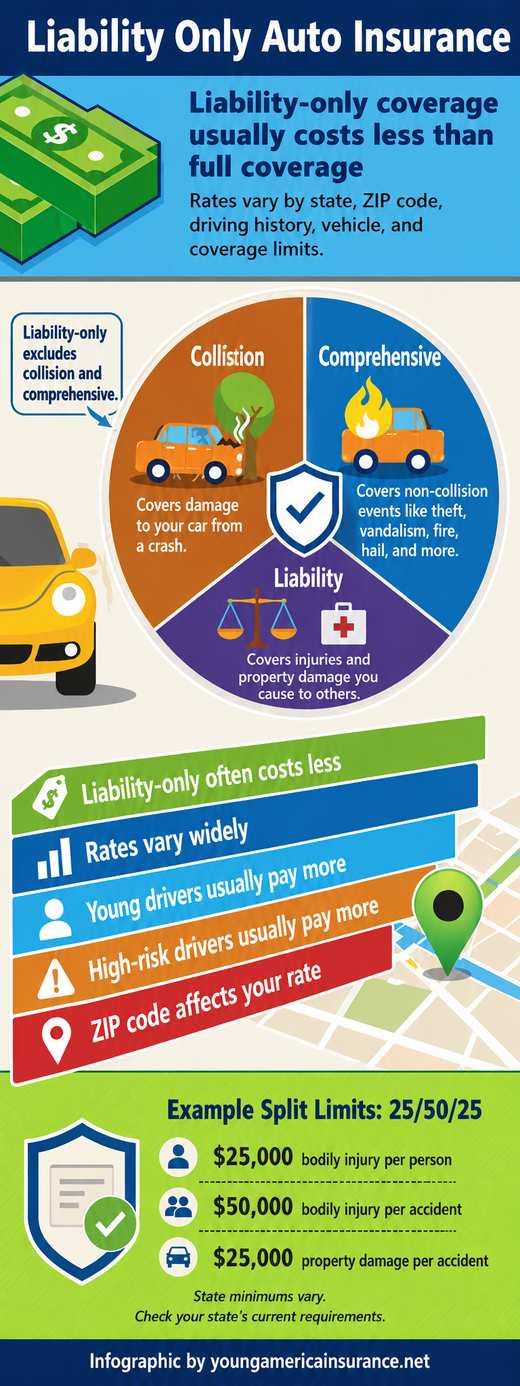
Liability Policies Cost Less
Liability policies are much cheaper than policies that also include collision and comprehensive insurance, but they offer less coverage, which you need to consider before buying a policy. For example, if you get into a severe accident that you are responsible for, your liability coverage may not be enough to pay all of the medical and property damages if the claims exceed your policy limits. You could end up responsible for damages above those limits and potentially face an expensive judgment. If you choose liability auto insurance, it’s wise to consider higher limits to have more financial protection.
Are you interested in saving the most money on your auto insurance? If you answered yes to some of these questions, then you might take a close look into a liability-only auto insurance policy. While the coverage is limited, it can cost substantially less than a policy that also includes collision and comprehensive coverage. How much you can save depends on your location, driving record, vehicle, insurer, coverage limits, and other rating factors.
Auto Insurance or Financial Responsibility Is Required in Most States
If you operate a motorized vehicle in the U.S., you will generally need liability insurance or another legally accepted form of financial responsibility. New Hampshire generally does not require every driver to maintain auto insurance, although drivers can still be held financially responsible for accidents they cause and insurance may be required in certain circumstances. Even if you live in New Hampshire, carrying auto insurance can provide important financial protection.
Each state sets its own insurance laws, including minimum coverage requirements. Before you buy a policy, you should take a few minutes and study the auto insurance laws where you live.
What Liability Only Auto Insurance Covers
Liability car insurance is designed to pay covered claims, up to the policy limits, when you are legally responsible for an accident.
You will generally be covered for the following:
Bodily Injury
If you hit another vehicle and are ruled to be at fault, bodily injury liability coverage can pay covered medical and injury-related costs for the other driver and passengers. The amount covered will depend on the limits you choose. With medical care costs being substantial, it’s wise to consider whether higher limits are appropriate for your situation. State minimum coverage may not be enough to cover bodily injuries in a severe vehicle accident.
Property Damage
If you are ruled at fault for an accident that damages another party’s property, liability insurance can pay for the covered damages up to the policy limits. This is often the vehicle you damaged in an incident you caused, but it can also include other property. For example, if you backed into a vehicle in a parking lot and caused $2,000 in automobile body damage, your property damage liability coverage could pay the covered claim, subject to your policy terms and limits.
What Liability-Only Auto Insurance Does Not Cover
The main limitation of liability-only insurance is that it generally does not pay to repair or replace your own vehicle after an at-fault accident. That protection normally comes from collision coverage.
Liability-only coverage also generally does not pay for theft, vandalism, fire, hail, flooding, animal strikes, or many other non-collision losses to your vehicle. Those types of losses are normally handled by comprehensive coverage.
Depending on your state, a policy commonly described as “liability only” may still need to include other legally required coverages, such as personal injury protection (PIP) or uninsured motorist coverage. If your vehicle is financed or leased, your lender or leasing company will also typically require collision and comprehensive coverage.
Liability Only Car Insurance Limits
The payout your insurance company makes for a liability automobile insurance claim depends on the coverage limits you select and the terms of your policy. Each state in the U.S. has insurance laws and minimum requirements for drivers.
You must satisfy the minimum auto insurance or financial responsibility requirements that apply where your vehicle is registered, but you are generally free to purchase additional liability coverage. Remember, auto insurance is there in part to protect you financially. If you have significant income or assets to protect, consider whether limits above your state minimum would provide more appropriate protection.
Liability Car Insurance Coverage Requirements by State
The table below shows bodily injury and property damage liability limits as of 2026. Some states require additional coverage, including PIP, uninsured motorist, underinsured motorist, or medical payments coverage. Requirements can change, so verify current rules with your state insurance department or motor vehicle agency before purchasing or changing coverage.
| State | Min Bodily Injury Per Person | Min Bodily Injury Per Accident | Min Property Damage Per Accident |
|---|---|---|---|
| Alabama | 25k | 50k | 25k |
| Alaska | 50k | 100k | 25k |
| Arizona | 25k | 50k | 15k |
| Arkansas | 25k | 50k | 25k |
| California | 30k | 60k | 15k |
| Colorado | 25k | 50k | 15k |
| Connecticut | 25k | 50k | 25k |
| Delaware | 25k | 50k | 10k |
| District of Columbia | 25k | 50k | 10k |
| Florida* | N/A | N/A | 10k |
| Georgia | 25k | 50k | 25k |
| Hawaii | 40k | 80k | 20k |
| Idaho | 25k | 50k | 15k |
| Illinois | 25k | 50k | 20k |
| Indiana | 25k | 50k | 25k |
| Iowa | 20k | 40k | 15k |
| Kansas | 25k | 50k | 25k |
| Kentucky | 25k | 50k | 25k |
| Louisiana | 15k | 30k | 25k |
| Maine | 50k | 100k | 25k |
| Maryland | 30k | 60k | 15k |
| Massachusetts | 25k | 50k | 30k |
| Michigan** | 50k | 100k | 10k |
| Minnesota | 30k | 60k | 10k |
| Mississippi | 25k | 50k | 25k |
| Missouri | 25k | 50k | 25k |
| Montana | 25k | 50k | 20k |
| Nebraska | 25k | 50k | 25k |
| Nevada | 25k | 50k | 20k |
| New Hampshire*** | 25k | 50k | 25k |
| New Jersey**** | 35k | 70k | 25k |
| New Mexico | 25k | 50k | 10k |
| New York | 25k | 50k | 10k |
| North Carolina | 50k | 100k | 50k |
| North Dakota | 25k | 50k | 25k |
| Ohio | 25k | 50k | 25k |
| Oklahoma | 25k | 50k | 25k |
| Oregon | 25k | 50k | 20k |
| Pennsylvania | 15k | 30k | 5k |
| Rhode Island | 25k | 50k | 25k |
| South Carolina | 25k | 50k | 25k |
| South Dakota | 25k | 50k | 25k |
| Tennessee | 25k | 50k | 25k |
| Texas | 30k | 60k | 25k |
| Utah | 30k | 65k | 25k |
| Vermont | 25k | 50k | 10k |
| Virginia | 50k | 100k | 25k |
| Washington | 25k | 50k | 10k |
| West Virginia | 25k | 50k | 25k |
| Wisconsin | 25k | 50k | 10k |
| Wyoming | 25k | 50k | 20k |
* Florida: Florida generally requires at least $10,000 in property damage liability and $10,000 in personal injury protection (PIP). Bodily injury liability requirements can apply in certain circumstances.
** Michigan: $50,000/$100,000 is the lowest bodily injury liability limit a driver may select. Michigan also has separate PIP and property protection insurance requirements.
*** New Hampshire: New Hampshire generally does not require every driver to purchase auto insurance. The limits shown apply when a motor vehicle liability policy or proof of financial responsibility is required.
**** New Jersey: The 35/70/25 figures apply to the Standard Auto Insurance Policy for policies issued or renewed on or after January 1, 2026. New Jersey also offers a Basic Policy with different provisions.
How Liability Only Insurance Limits Work
When you buy a policy, there are two main liability coverage types: bodily injury and property damage. However, liability limits are commonly shown as three numbers because bodily injury coverage has both a per-person and a per-accident limit.
For example, a 25/50/25 policy generally means $25,000 of bodily injury liability coverage per person, $50,000 of bodily injury liability coverage per accident, and $25,000 of property damage liability coverage per accident.
Coverage for Property Damage
When you choose your property damage liability limit, this is the maximum amount the auto insurance carrier can pay for covered property damage you cause in an accident, subject to the terms of your policy. You can increase coverage by raising the limit.
Bodily Injury per Person and per Accident
These coverage amounts cap the amount available for covered bodily injury claims for each injured person and the total amount for one accident. These limits are important because a serious accident involving several injured people can result in claims that exceed relatively low policy limits, at which point you may be personally responsible for additional damages.
State Minimum Liability Only Laws
You might be tempted to go for the cheapest liability auto insurance by choosing only the minimum coverage required by your state. While this can reduce your premium, minimum limits may leave you with substantial financial exposure after a serious at-fault accident.
With medical care and vehicle repair costs rising over time, you need to consider protecting yourself from a severe at-fault accident. This means considering higher liability limits if you can reasonably afford them. There is no single liability limit that is right for every driver. Your financial situation, assets, income, state requirements, and the cost of higher coverage should all be considered.
If a vehicle is in storage or is hardly ever used, do not automatically assume that minimum coverage can be reduced or cancelled. Insurance and registration requirements vary by state, and some states require continuous coverage while a vehicle remains registered.
Very low advertised liability rates can be tempting, but price should not be the only factor you consider. You can use resources such as Young America Auto Insurance to learn about available quote options and compare coverage. When shopping, make sure you compare policies using the same coverage limits so that a lower price does not simply reflect less protection. There are also other ways to keep insurance costs down without automatically choosing the lowest available limits.
When Does Liability-Only Auto Insurance Make Sense?
Liability-only automobile insurance might make sense if your vehicle is paid off, has relatively low market value, and you could afford to repair or replace it yourself if it were damaged or totaled. It may also be worth considering for a second vehicle that is driven infrequently.
However, an older vehicle does not automatically mean liability-only coverage is the right choice. Compare the value of your vehicle with the cost of collision and comprehensive coverage, consider the deductibles, and think about how difficult it would be financially to replace the car yourself.
Shop for Cheap Liability Only Auto Insurance Online
Thanks to instant information online, anyone can compare rates on liability-only car insurance in a fraction of the time it used to take calling several agents. With online insurance comparison resources, you can review available quote options from your smartphone or laptop.
Comparison shopping can help you identify competitive auto insurance rates. Young America Insurance is an online insurance information and quote comparison resource that helps consumers connect with available quote options. The actual insurers, agencies, marketplaces, or providers involved determine eligibility, pricing, and policy terms.
Buying online gives you more control over the shopping process. It allows you to compare coverage options and look for a policy that fits your budget while providing the protection you need. Make sure you compare the same liability limits and required coverages from one quote to another.
Buying liability-only car insurance online can be convenient, but do not choose a policy solely because it has the lowest advertised monthly payment. Review the limits, required upfront payment, fees, exclusions, and policy terms before purchasing coverage. Enter your ZIP code to compare available quote options.