Cheap Liability Car Insurance in Phoenix, AZ: Real 2026 Costs + Best Ways to Save
How we update this page
What “rates” mean: The prices below are market averages from third-party datasets and can differ from your personal quote.
What can change your quote fast:
- ZIP code, vehicle, driving record, and credit-based insurance score (where allowed).
- Coverage limits (state minimum vs. higher liability limits).
- Discount eligibility (telematics/usage-based, bundling, autopay, pay-in-full, low mileage).
Auto insurance in Phoenix is expensive compared to many U.S. cities, so it’s normal to look for a cheaper option like liability-only coverage. Current market snapshots put full coverage in Phoenix around $2,943/year (~$245/month), while state-minimum coverage averages about $886/year (~$74/month). Those are “typical” numbers — your personal rate can be lower or higher depending on your ZIP code, driving history, vehicle, and discounts.
Liability-only coverage is significantly cheaper than a full coverage car insurance policy, but it won’t pay for your own car repairs after an at-fault crash. This guide breaks down Arizona’s minimum requirements, which companies are commonly competitive in Phoenix, and the most reliable ways to cut your premium without cutting corners.
Arizona’s Minimum Liability Requirements (25/50/15)
Every driver in Arizona must carry at least the state-mandated minimum liability coverage:
$25,000 bodily injury per person, $50,000 bodily injury per accident, and $15,000 for property damage.
These limits are often written as 25/50/15.
These minimums protect other people if you cause a crash. They don’t pay for your own injuries or your own vehicle repairs — which is why minimum coverage usually makes the most sense for older vehicles, low-mileage drivers, or people who mainly need to stay legal.
Arizona also verifies insurance electronically. Driving without at least the minimum required coverage can trigger penalties like fines and registration or license issues, so keeping a valid policy active matters even if you’re shopping for a better price.

What “Cheap” Looks Like in Phoenix (Real 2026 Benchmarks)
Using Phoenix market averages as a reality check:
- State minimum coverage: about $886/year (~$74/month).
- Mid-level liability-only example limits (like 50/100/50): about $1,295/year (~$108/month).
- Full coverage: about $2,943/year (~$245/month).
If you’re getting quotes far above these ranges with a clean record, it’s a sign you should shop more carriers, verify your garaging ZIP code, and double-check discount eligibility.
The Most Competitive Liability Insurers in Phoenix
There isn’t a single “always-cheapest” company for every driver. But in Phoenix, large pricing studies often show
American Family, Travelers, and GEICO among the more affordable options for many driver profiles — especially drivers with good credit and clean records.
(That doesn’t mean they’ll be cheapest for you, but they’re usually worth quoting.)

Travelers — Often Competitive in Phoenix
Travelers shows up as one of the cheaper options in Phoenix for many driver profiles in large pricing datasets. It’s also a strong “compare it” insurer because discounts (multi-policy, safe driver, autopay) can move your quote a lot.

GEICO — Fast Quotes + Strong Discount Stack
GEICO is often competitive for experienced drivers and people who qualify for multiple discounts (good driver, bundling, good student, vehicle safety features, autopay/paperless). It’s a good “baseline quote” to compare against other carriers.

Mercury — Local Presence in Phoenix
Mercury is worth quoting if you prefer local support and want to compare agent-assisted options. In Arizona pricing studies, Mercury can be very competitive for minimum coverage for some driver profiles, especially when discounts apply.

Root — Good Fit for Safe, Low-Mileage Drivers
Root is a telematics-first insurer. Your quote is based heavily on how you drive during a short “test drive” period using the Root app. If you drive smoothly and don’t rack up risky behaviors, it can be a strong low-cost option.

Acceptance — Often Considered by High-Risk Drivers
If you’ve had tickets, accidents, or a lapse in coverage, you may need to compare “standard” insurers and non-standard options. Acceptance markets coverage for drivers who may be considered higher risk, and can be worth a quote if other carriers come back high.
It’s an excellent car insurance choice for high-risk drivers to compare against the bigger brands.
The Overall Cheapest Pick (Realistic Take)
In Phoenix pricing analyses, American Family has been cited as an especially low-cost option for liability coverage for some driver profiles, while Travelers and GEICO are frequently competitive.
The “best” insurer is the one that gives you the best quote after discounts — so the smartest move is to compare at least 3–5 companies on the same day.
Minimum Liability Auto Insurance Rates For Good Drivers
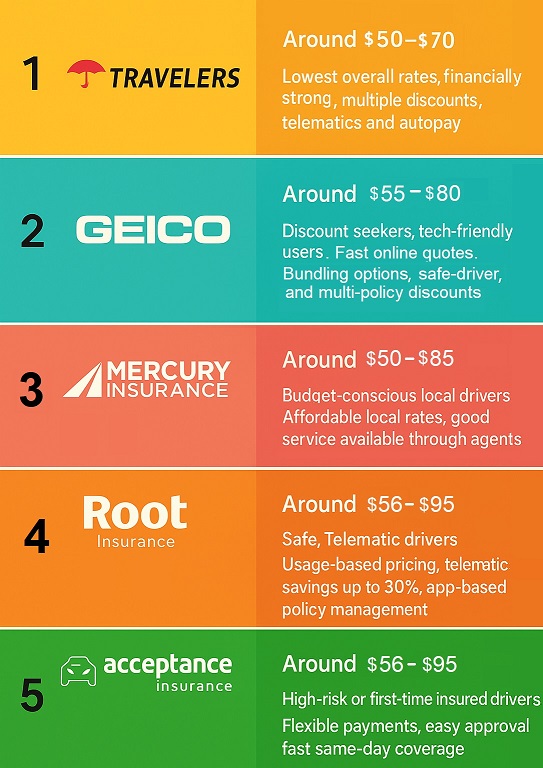
Pro Tip: Telematics Can Be a Real Discount (But It Can Cut Both Ways)
One of the fastest ways to lower your Phoenix premium is a usage-based/telematics program. These programs measure driving behavior (like hard braking, time of day, and mileage) and can reward safer habits with meaningful savings.
As examples: Travelers says its IntelliDrive program can offer savings of up to 30%, and GEICO’s DriveEasy has been associated with discounts that can reach the mid-20% range depending on your state and driving score.
Just remember: if the data shows risky driving, your price may not improve — so only opt in if you’re comfortable with the tracking and you’re confident in your driving habits.
How ZIP Codes Affect Rates in Phoenix
Phoenix is huge, and rates can swing a lot by neighborhood. Higher-traffic areas and places with higher theft or claim frequency often cost more, while some suburban ZIP codes can be cheaper.
If you moved recently (even within Phoenix), updating your garaging address can change your rate immediately — sometimes for the better.
Simple Ways to Save on Liability-Only Coverage

Bundle Policies
Bundle auto + renters/homeowners for a multi-policy discount (if you actually need both).

Pay in Full
If you can, pay in full to avoid installment fees and sometimes unlock extra savings.

Stay Covered
Avoid lapses. Continuous coverage is one of the simplest ways to prevent rate spikes.

Autopay + Paperless
Many insurers discount automatic payments and paperless billing.

Ask About Discounts
Good student, defensive driving, low mileage, military/federal, employer groups, and more.
Stack discounts the right way and you can meaningfully reduce your premium — sometimes without changing coverage.
Tips for Teen Drivers in Phoenix
Teen drivers pay more for insurance
because insurers see them as higher risk. Liability-only can keep the bill manageable, but the real savings usually comes from:
staying on a parent’s policy, keeping grades up for a good-student discount, choosing a modest vehicle, and avoiding tickets.
After 6–12 months of clean driving, you’ll often see improvements at renewal — which is a good time to re-shop.
How Senior Drivers Can Save on Phoenix Liability Insurance
Seniors with clean histories often get strong rates, but premiums can rise with age in later years. The best levers are:
low-mileage programs (if you drive less), defensive-driving refreshers where available, and
bundling home and auto coverage
if it truly fits your situation. Also consider re-quoting every renewal — loyalty doesn’t always pay in 2026 pricing.
When Minimum Coverage Isn’t Enough
Arizona’s 25/50/15 minimums meet the law, but they can be too low in a serious crash — especially if multiple people are injured or property damage is significant.
If you have savings, income to protect, or anything to lose in a lawsuit, consider stepping up to 50/100/50 or 100/300/50.
The increase is often smaller than people expect compared to the extra protection you get.
How to Shop Smart for Cheap Liability Car Insurance in Phoenix
⭐ Gather your details: driver’s license, VIN, address, and current policy (if any).
⭐ Choose limits first: state minimum or a safer step-up like 50/100/50.
⭐ Get 3–5 quotes: include at least one “big brand” and one alternative option.
⭐ Apply discounts: telematics, bundling, autopay, pay-in-full, low-mileage, good student.
⭐ Re-shop every renewal: pricing changes fast in Phoenix.
Even one extra quote can save you real money over a year.
Frequently Asked Questions
Q: What’s the cheapest liability-only insurance in Phoenix?
A: It depends on your profile, but large Phoenix pricing studies often show American Family, Travelers, and GEICO among the cheaper options for many drivers.
Always compare multiple companies because your ZIP code and history can flip the rankings.
Q: How much does liability-only insurance cost in Phoenix?
A: A helpful benchmark is that state-minimum coverage averages around $74/month in Phoenix, while mid-level liability-only (higher limits) averages around $108/month.
Excellent and low-mileage drivers can pay lower rates.
Q: Is liability-only coverage enough for me?
A: It’s usually enough if your car is older and you can afford to replace it. If you want protection for your own vehicle, consider adding
comprehensive coverage
(and collision if you want crash damage covered).
Q: Can I get liability-only if I’m still paying off my car loan?
A: Usually no — lenders typically require collision and comprehensive until the loan is paid off.
Q: How often should I get new quotes?
A: At least every 6–12 months, and anytime you move ZIP codes, add a driver, or change vehicles.
The Final Word on Cheap Liability Car Insurance in Phoenix
Liability-only car insurance is one of the easiest ways to stay legal in Phoenix while keeping costs under control.
Use the Phoenix benchmarks (about $74/month for state minimum, ~$108/month for higher liability-only limits) to sanity-check your quotes, then shop at least 3–5 insurers.
If you’re a safe driver, telematics programs can be a powerful lever; if you’re a teen or senior, the biggest wins usually come from discount strategy and policy structure.
Whether you’re cutting costs or staying compliant, the right liability policy keeps you legal and financially protected on Phoenix roads.
Data notes: Arizona minimum limits per AZDOT. Phoenix average costs and ZIP-code variation from large pricing datasets cited by Insure.com and NerdWallet. Telematics discount ranges based on program disclosures from major insurers.