Seattle Liability Insurance: Minimum Limits and Ways to Compare
By Young America Insurance Editorial Team | Updated September 2026
Seattle drivers looking for the lowest monthly premium often consider liability-only car insurance. Unlike full coverage auto insurance, liability coverage generally pays for injuries or property damage you cause to other people, up to the policy limits. It does not normally pay to repair or replace your own vehicle after an at-fault accident.
Your price can vary considerably based on factors such as your driving record, ZIP code, vehicle, annual mileage, coverage limits, and insurance history. Washington insurers may also use credit-based insurance information subject to state law. Because every insurer evaluates these factors differently, no single company is guaranteed to be the cheapest for every Seattle driver.
Washington’s Minimum Liability Requirements
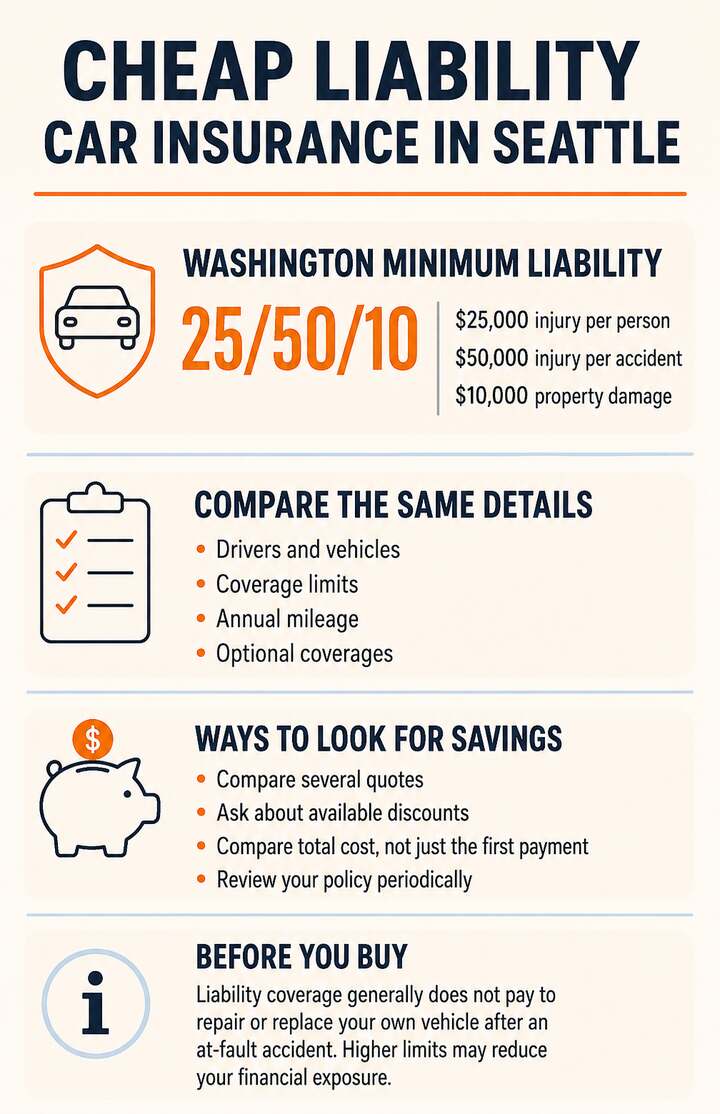
Washington operates under an at-fault insurance system, meaning the driver responsible for a crash may be liable for the other party’s injuries and property damage. According to the Washington State Office of the Insurance Commissioner, the minimum liability limits are:
- $25,000 for injuries to or death of one person
- $50,000 for injuries to or death of two or more people
- $10,000 for damage to another person’s property
These limits are commonly written as 25/50/10. They satisfy the state’s basic insurance requirement, but the amount an injured party can recover from your policy is limited. A serious injury or damage to an expensive vehicle could exceed the minimum limits, leaving the at-fault driver responsible for the remaining amount. Higher limits such as 50/100/50 or 100/300/100 may provide more protection, but the appropriate limits depend on your finances, assets, risk tolerance, and budget.

Liability Insurance Companies to Compare in Seattle
State Farm, GEICO, Progressive, PEMCO, and Nationwide are among the insurers Seattle drivers may encounter when comparing coverage. Availability and pricing depend on the applicant, and this list is not a ranking. A company that offers a competitive premium to one driver may be considerably more expensive for another.
| Company | What to compare |
|---|---|
| State Farm | Ask about eligibility, available discounts, payment options, and whether service is provided through a local agent. |
| GEICO | Compare the online quote, available discounts, optional coverages, and policy-service options. |
| Progressive | Review the standard quote and any usage-based option separately, including how driving data may affect the premium. |
| PEMCO | Check eligibility, Washington availability, coverage choices, discounts, and the quoted premium for your profile. |
| Nationwide | Compare multi-policy and multi-vehicle options, payment plans, and any usage-based program offered in Washington. |
Request quotes using the same drivers, vehicles, liability limits, annual mileage, and optional coverages. Otherwise, a lower price may simply reflect less protection. You should also check whether a quote includes fees or discounts that may change at renewal.
Is There One Cheapest Liability Insurer in Seattle?
No company is consistently cheapest for every driver or every Seattle ZIP code. Insurers use different rating models, and premiums can change after approved rate revisions. The most reliable way to identify the lowest available price for your situation is to compare quotes from several insurers using identical information and coverage limits.
Price should not be the only consideration. Compare liability limits, exclusions, customer-service options, available payment plans, and the financial exposure you would retain after an at-fault accident. Auto insurance requirements and policy structures vary across the United States, and selecting Washington’s minimum coverage may reduce the premium while transferring more financial risk to you.
How to Buy Seattle Liability Auto Insurance and Save
1. Review the information used for your quote
Check that your address, drivers, vehicles, annual mileage, and driving history are accurate. Washington law permits regulated use of credit-based insurance information, so reviewing your credit reports for errors may also be relevant. Learn more about how this factor relates to car insurance and credit history.
2. Compare equivalent quotes
Collect several quotes using the same liability limits, drivers, vehicles, and mileage. If you work remotely or use public transportation frequently, report your expected annual mileage accurately rather than relying on a default estimate. Whether lower mileage changes the price depends on the insurer.
3. Consider usage-based insurance carefully
Some companies offer usage-based insurance programs that evaluate mileage or driving behavior. These programs may help some drivers, but savings are not guaranteed. Before enrolling, check what information is collected, how it is used, whether participation can increase the premium, and whether the program suits your driving habits.
4. Compare payment options
Insurers may offer monthly, semiannual, or annual payments. Paying the full term may avoid installment fees, but it requires more money upfront. Before choosing a car insurance payment plan, compare the total policy cost rather than only the first payment.
How Discounts May Affect the Price
Discounts vary by insurer and driver. Possible examples include multi-policy, multi-car, safe-driver, automatic-payment, paperless-billing, good-student, and usage-based discounts. If you rent or own a home, compare the total cost of separate policies with the cost of bundling auto and home or renters insurance. A bundle is not automatically cheaper, so compare the final premiums and coverage in both scenarios.
Ask each insurer which discounts are included in the initial quote, how long they last, and what could cause them to be removed. A low introductory premium does not establish what you will pay at renewal.
Liability Car Insurance for Teens in Seattle
Teen drivers generally face higher premiums because they have less driving experience. Keeping a teen on a household policy is often worth comparing with a separate policy, but the less expensive option depends on the household, vehicles, insurer, and available discounts.
Ask about good-student and approved driver-education discounts, including the eligibility requirements and documentation needed. Because programs vary, do not assume a particular grade or course will qualify without confirming it with the insurer. Our guide to insurance options for higher-risk drivers explains other factors that may affect the price.
Vehicle choice can also affect the premium. Before buying or assigning a vehicle to a teen, request quotes for the specific models under consideration. The price may reflect repair costs, safety features, theft history, and claim experience—not merely the vehicle’s age or purchase price.
Liability Car Insurance for Seniors in Seattle
Some senior drivers travel fewer miles after retirement, while others maintain the same driving patterns. Report anticipated mileage accurately and ask whether the insurer offers a low-mileage, mature-driver, or approved driving-course discount. Eligibility and savings vary.
Safety equipment may affect pricing with some insurers, but discounts are not automatic. Compare quotes for the same vehicle and limits, and review the policy each year for changes in premium, coverage, or available discounts.
FAQs About Cheap Liability Car Insurance in Seattle
What is the legal minimum to drive in Washington?
Washington generally requires liability limits of $25,000 for injury or death to one person, $50,000 for injury or death to two or more people, and $10,000 for damage to another person’s property.
Does Washington require uninsured motorist coverage?
Uninsured and underinsured motorist coverage is not part of the state’s basic liability requirement. Review the offer and rejection requirements with a licensed insurer or agent before deciding whether to include it.
Why can Seattle rates differ from rates elsewhere in Washington?
Insurers may consider location-related claim experience and other approved rating factors. The effect of a Seattle ZIP code varies by insurer and driver, so obtain quotes rather than assuming a fixed city surcharge.
Who has the cheapest liability insurance in Seattle?
There is no universally cheapest insurer. The result depends on the driver, vehicle, address, limits, discounts, and other rating factors. Compare several quotes using identical information.
Is Washington’s minimum coverage enough?
It meets the state’s basic insurance requirement, but it may not cover the full cost of a serious accident. Consider your assets, budget, and potential exposure when choosing limits.
Can a telematics program lower my premium?
It may lower the premium for some drivers, but the result depends on the program and recorded driving behavior. Review its data practices and whether unfavorable driving information can affect your price before enrolling.
Final Thoughts on Cheap Liability Car Insurance in Seattle
Finding affordable liability insurance requires a consistent comparison rather than relying on one company’s advertised or average price. Request quotes from several insurers on the same day using the same drivers, vehicles, mileage, limits, and optional coverages.
Washington’s minimum 25/50/10 limits may produce a lower premium, but higher limits can reduce your financial exposure after an at-fault accident. Compare the additional cost before deciding which limits fit your circumstances.
Review your policy periodically, maintain accurate information, avoid coverage lapses, and compare the total cost after fees and discounts. The cheapest quote is useful only when it provides the coverage you intended to buy.